

Johor Factory Walkways: Grip and Traffic
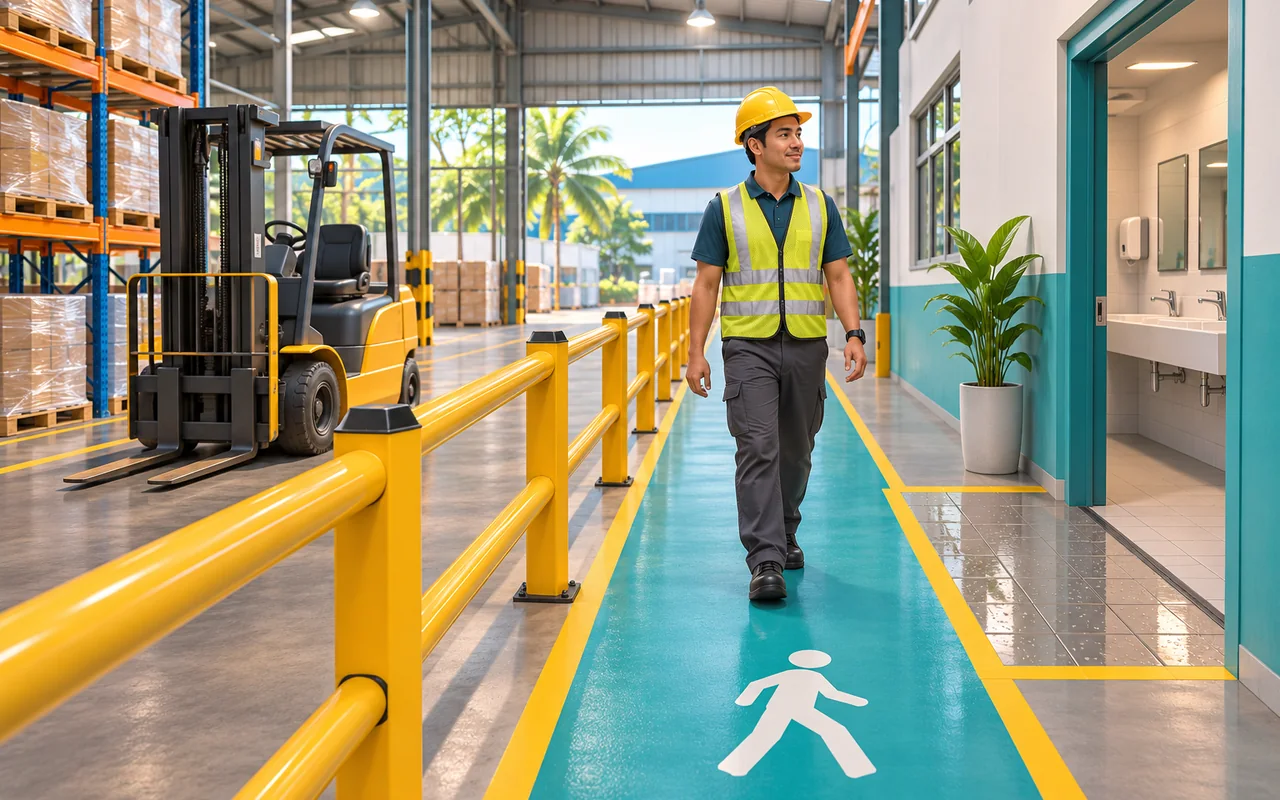
A painted walkway tells people where to walk. It does not, by itself, keep a forklift out or establish that the floor has suitable traction. When a Johor factory requests anti-slip work, the specification should identify the walking-surface problem without confusing it with traffic control.
Start with the pedestrian journey: from the entrance to workstations, washrooms, changing facilities and rest areas. A route may cross several surfaces and wet transitions before reaching the production floor. Those boundaries deserve a closer look than a single broad “factory floor coating” description.
Illustration; not a Nano Step client project.
Put the concern into the site's risk assessment
Malaysia's DOSH explains HIRARC as hazard identification, risk assessment and risk control. Use the site's own safety process to establish who is exposed, when the issue occurs and which controls are needed. A floor contractor's quotation should support that process, not replace it.
Create a marked route plan with the safety and facilities teams. Note pedestrian doors, crossings, blind corners, wash points and places where footwear carries water between areas. Include infrequent journeys such as visiting drivers reaching an office or contractors accessing a service room.
Ask staff for descriptions of recurring problems without requiring them to recreate a slip. Their observations can help target an assessment while keeping reported facts separate from assumptions.
Separate vehicle controls from grip controls
The UK's HSE guidance on separating pedestrians and vehicles recommends separate routes where possible and describes barriers, crossings and clear markings. These principles concern traffic interaction. They do not establish the slip resistance of the walking surface, and the cited UK legal provisions do not determine Malaysian compliance.
For planning, keep two work lists:
| Walking-surface questions | Traffic-management questions |
|---|---|
| Where does water or residue reach the path? | Where can a vehicle enter the pedestrian route? |
| Is the surface sound and even? | Are crossings visible and appropriately controlled? |
| What conditions should a grip assessment represent? | How are staff and visitors directed? |
| Which finish and preparation suit the pedestrian area? | Who controls vehicle movement during work? |
The right solution may require separate trades and management decisions. Anti-slip treatment does not create a collision barrier.
Find the source of the wet transition
Inspect where the condition changes: outside a washroom, beside a washdown boundary, under a leak or at a doorway used by wet boots. Record whether the problem follows a particular task or shift. Do not infer that the whole factory needs the same treatment because one transition is slick.
Ask the site team to investigate the source and agree what can be prevented or contained. Then define any remaining surface-grip assessment. If oil or another substance is involved, tell the assessor what it is; a water-only demonstration should not silently stand in for all operating conditions.
Our commercial anti-slip service explains the assessment path for existing floors. Suitability must be confirmed for the actual substrate, contamination and use. Do not assume a pedestrian treatment is specified for forklift loading or chemical exposure.
Protect the route during floor work
Agree the work boundary on the route plan. Identify a protected alternative for pedestrians and confirm how contractors will move equipment without entering active traffic unexpectedly. Keep the site's traffic controller and safety representative involved in closure and reopening decisions.
Plan around shift changes, deliveries and washdown schedules. “After hours” is not automatically quiet in a multi-shift factory. Ask which operations will remain active and who has authority to stop or divert them.
At handover, compare the completed area with the agreed boundary. Check that adjoining markings, drains and thresholds have been considered, and record unfinished repairs separately. Give the responsible team the care guide and any assessment records commissioned for the job.
Frequently Asked Questions
Can an anti-slip coating replace pedestrian barriers?
No. Surface traction and vehicle separation address different hazards. The site needs an appropriate plan for both.
Should forklift lanes receive the same system?
Do not assume so. Vehicle loads and operating conditions need their own specification and suitability assessment.
Can work happen between shifts?
Only if the actual preparation, application and release conditions fit the available window. Confirm them before changing the site's route plan.
Plan the Johor visit
Review Johor coverage and available services, then send a WhatsApp enquiry with your town, postcode, route plan and operating hours. Outstation visits are scheduled; confirm timing and the assessment scope before arranging a closure.